
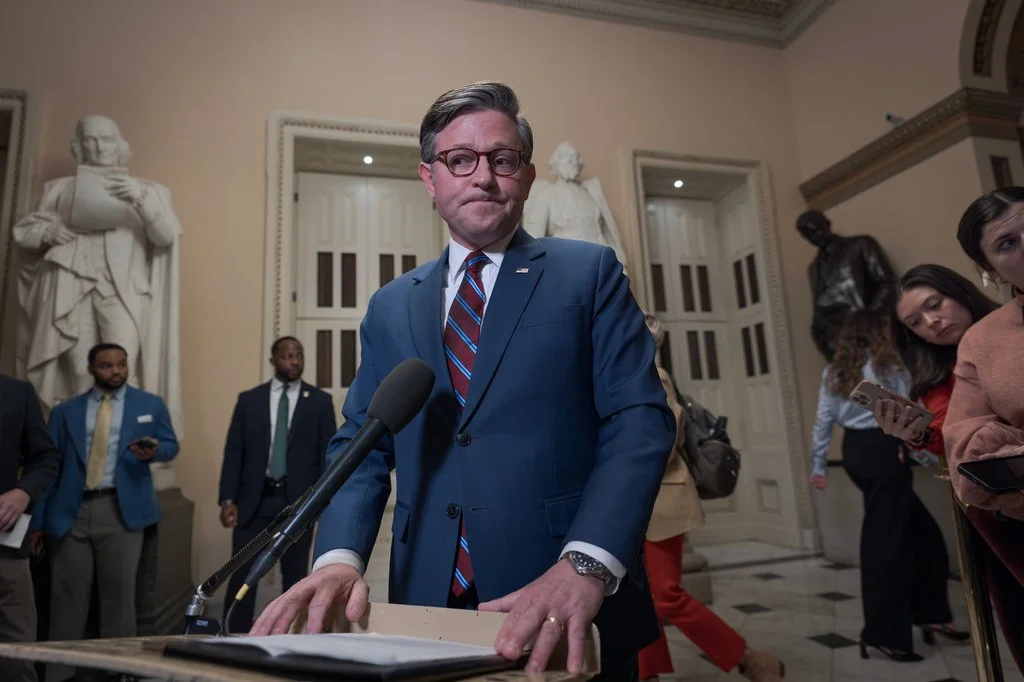
Speaker of the House Mike Johnson, R-La., meets with reporters as Congress returns to work following the sweeping victory by Democrats in the midterm elections, at the Capitol in Washington, Monday, Nov. 9, 2026. (AP Photo/J. Scott Applewhite)
This November, Democrats changed the tide in the House and Senate with a historic sweep. AP News reported that Democrats made gains in both chambers of Congress, securing at least 257 House seats and flipping nine Republican-held seats in the Senate. In Alaska, Mary Peltola’s victory over incumbent Sen. Dan Sullivan gave Democrats a 56–44 majority and marked the party’s largest midterm Senate gain since 1958, when Dwight Eisenhower was president.
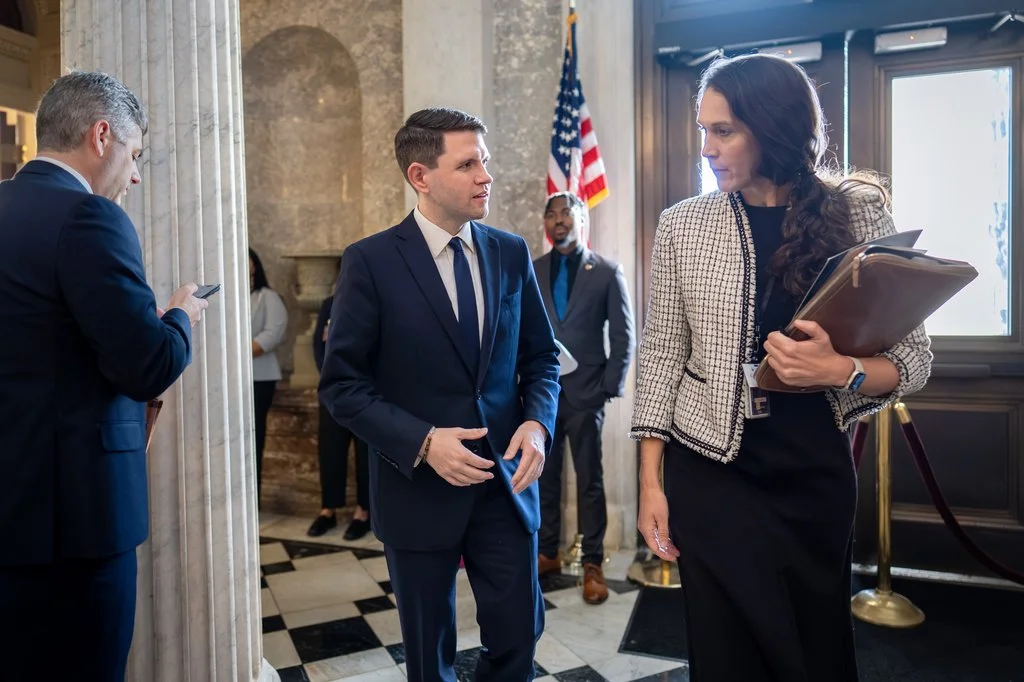
Sen.-elect James Talarico, D-Texas, center, is escorted through the Capitol as newly-elected senators arrive for orientation following a sweeping victory by Democrats in the midterm elections, in Washington, Monday, Nov. 9, 2026. (AP Photo/J. Scott Applewhite)
The question now is: what will the Democrats do with their new influence? In statements and interviews with Reuters, “prominent Democrats in the House of Representatives and Senate told Reuters their initial forays could address voter frustration over the Iran war, high consumer prices, and affordable healthcare.” Of special attention were remarks from the newly elected 2027 House Speaker and current House Democratic Leader Hakeem Jeffries, who stated: "We have to make sure that we're cleaning up the mess here in Congress with the executive branch and at the Supreme Court and that should begin by prohibiting members of Congress from trading stocks,” expressing the Democrats’ domestic priority to curb back allowances for congressional stock trading.
Thomas Wright, a senior fellow at the Brookings Institution, contends that the historic sweep poses the Democrats to be in a precariously important position going into December. With the majority, Democrats now have a chance to leverage Congressional powers against the formerly Republican US Capitol, but with the party split internally, this situation could quickly sour into a debilitating spot for US Foreign Policy. Wright contends, “the strategic environment in 2029 is on track to be the most difficult and unforgiving since the height of the Cold War” given the context of the Democrats’ interparty split.
Democrats are generally split into two camps: “centrists who, when it comes to foreign policy, are focused on strategic competition, restoring the United States’ national power, and deepening alliances” and “progressives, who propose a more affirmative agenda emphasizing shared challenges and global cooperation. ‘Winning an election will not mean the end of Trumpism.’”
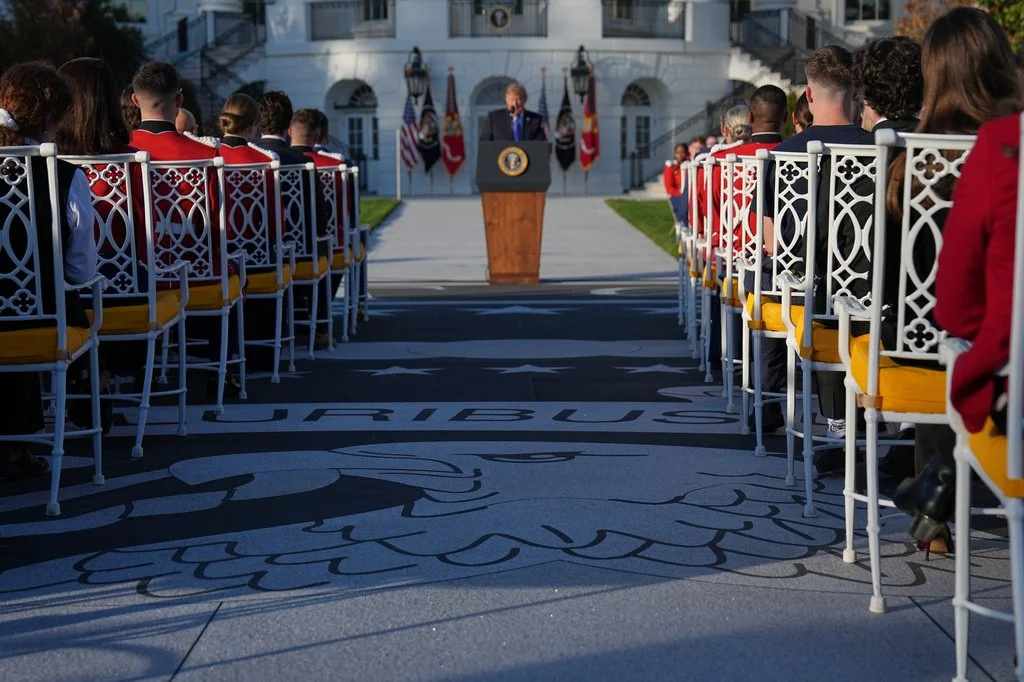
President Donald Trump speaks during an event on the helipad on the South Lawn of the White House, Friday, Nov. 20, 2026, in Washington. (AP Photo/Jacquelyn Martin)
Wright reflects that coming out of the Biden administration, centrists are actively debating “whether a future Democratic administration can restore and reform the U.S.-led international order or whether the United States must adapt to a prolonged period of geopolitical upheaval.” But centrists do all favor “deepening alliances and partnerships, modernizing the military, fixing the defense industrial base, strengthening deterrence, tackling transnational challenges such as global public health, and pursuing hardheaded diplomacy with rivals.” The real points of tension, though, are drawn between centrists’ belief that Trump has “severely weakened U.S. power and institutions,” but yet the world the next Democratic president would inherit (if one does come to power) would definitely not be the world Biden inherited in 2021 and so winning an election will not “mean the end of Trumpism.”
As similarly articulated by Ariane Tabatabai of the Chicago Council on Global Affairs, Wright posits that “Even if a Democratic president can rebuild American power and repair damaged institutions, restoring international confidence in the durability of U.S. commitments will be much harder.”
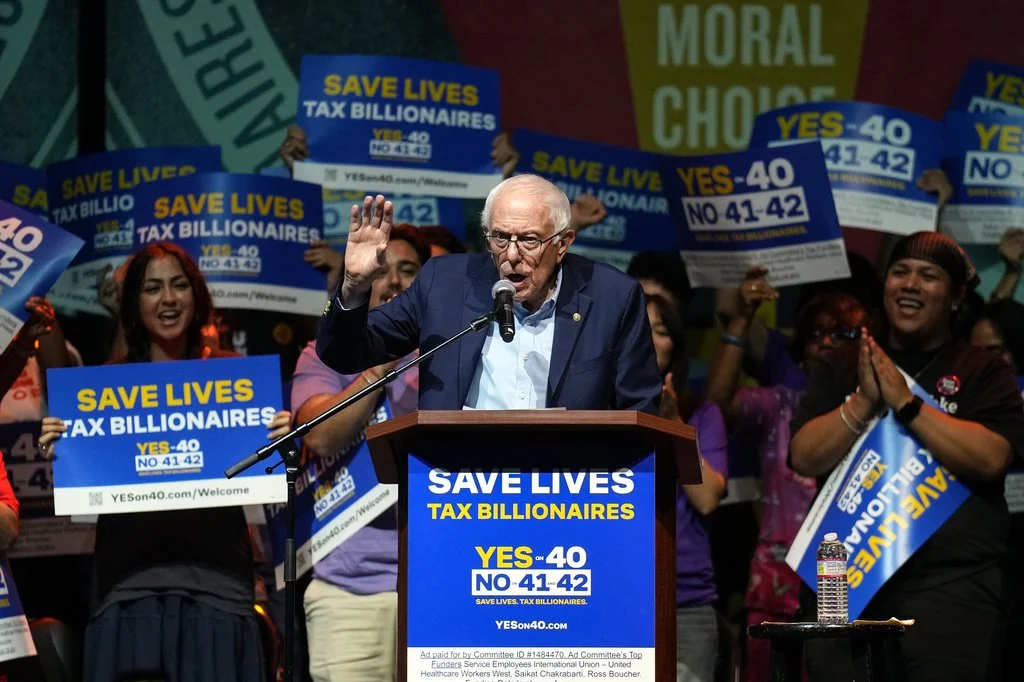
Sen. Bernie Sanders, I-Vt., speaks during a campaign rally in support of California Proposition 40, known as the billionaire tax, in Los Angeles, Monday, Oct. 5, 2026. (AP Photo/Jae C. Hong)
On the other hand, Democratic progressives “believe that a global oligarchy poses a threat to democracy and see big business in defense, technology, and finance as part of a corrupt system. They believe that corporate interests have driven excessive military spending, misguided interventions, and a global economy that favors multinational companies over workers.” In the realm of foreign policy, progressives point to the emergence of a multipolar order in which the US has an important but more limited role to play. According to the progressive thinker Ben Rhodes, a former deputy national security adviser to President Barack Obama, Washington should “re-engage the world as something other than a hegemon.”
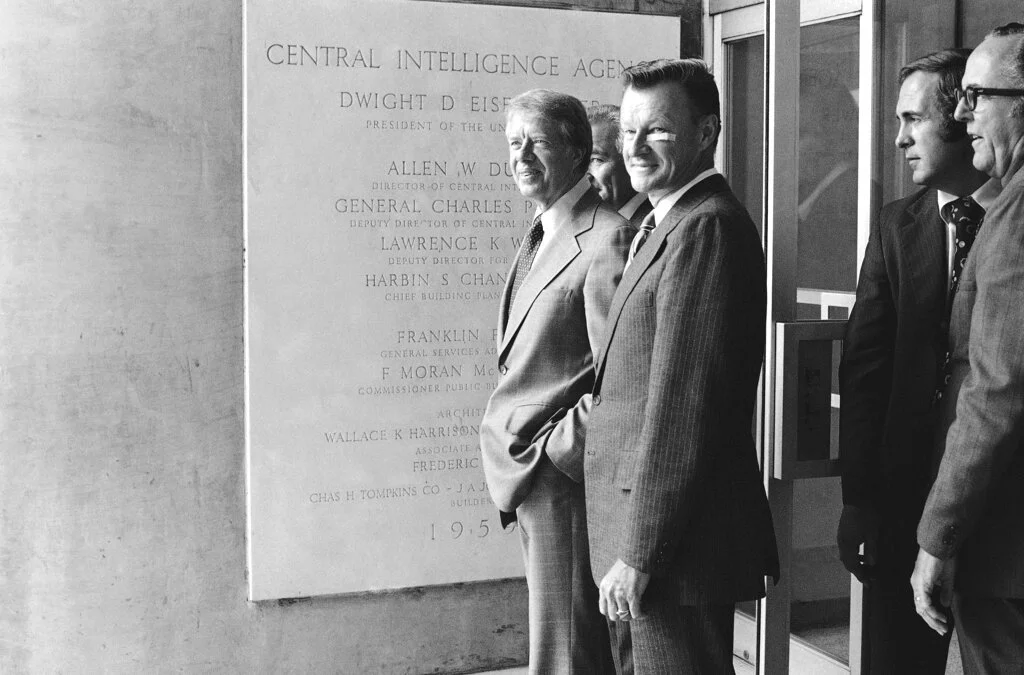
President Carter stands near the tablet at the main entrance on Wednesday, August 16, 1978, of the Central Intelligence Agency in McLean, Va., near Washington. From left are: Carter, CIA Director Adm. Stansfield Turner, partially obscured; and National Security Adviser Zbigniew Brzezinski. (AP Photo)
Wright points out that the centrist-progressive debate really runs deeper than just a disagreement over policy and might pose a serious threat to the future of the Democratic Party now that eyes are trained on them after the Midterms. In his words, “If the party does not have these debates openly and consistently over the next two years, a Democratic president risks entering office in 2029 much as Jimmy Carter did in 1977. Carter inherited an international environment in which the Nixon-Kissinger framework of détente was under increasing strain.”
If Democrats spend the next two years deferring an open debate over what the United States owes its allies and when it should confront its adversaries, they risk carrying those disagreements into the White House in 2029, much as Jimmy Carter did in 1977. That is to say, if Democrats take their win as is and do little to facilitate constructive open air debates for the public to become more informed. The US risks seriously debilitating the next Democratic president to take office, as Democrats could possibly destabilize their own party right when Americans will be scrutinizing them the most.
Wright drew on the Carter-Vance-Brzezinski case to exemplify that, when Carter inherited a policy of détente intended to ease tensions with the Soviet Union, a war between Ethiopia and Somalia soon exposed how differently his closest advisers understood that commitment. When Moscow intervened on Ethiopia’s behalf, National Security Adviser Zbigniew Brzezinski argued that allowing the intervention to go unanswered would embolden the Soviets elsewhere in Africa. Secretary of State Cyrus Vance saw a different danger. If Washington tied progress on nuclear arms control to Soviet conduct in a regional war, it could jeopardize an agreement that both countries had an interest in reaching.
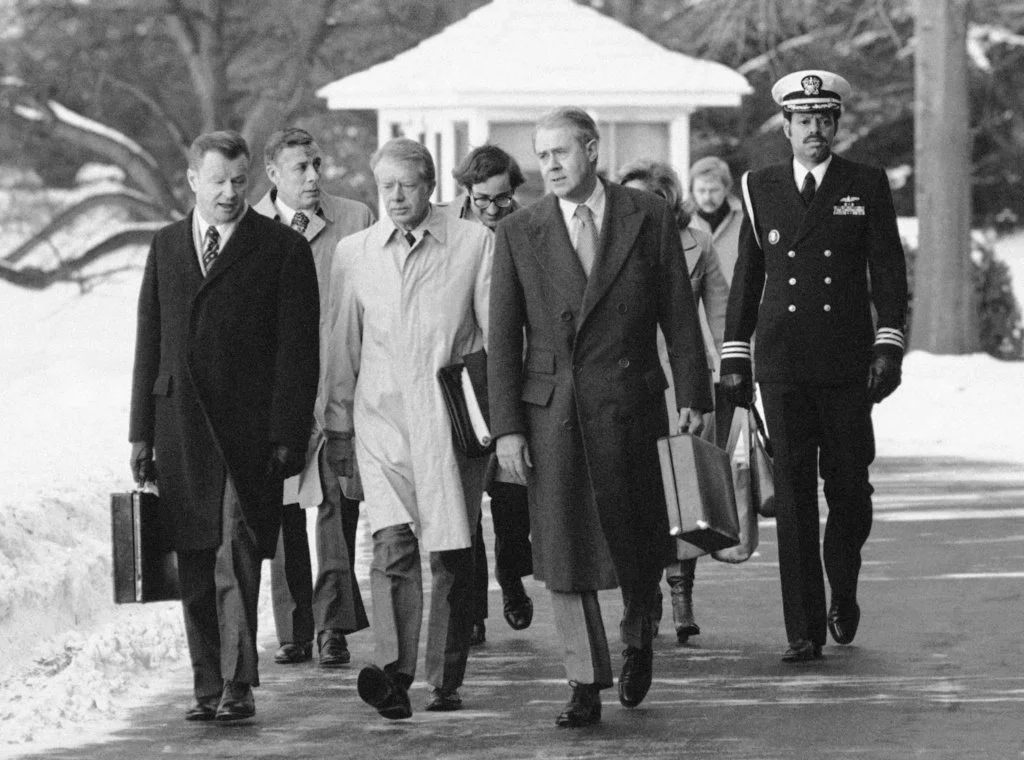
President Jimmy Carter, flanked by Secretary of State Cyrus Vance, right, and foreign policy adviser Zbigniew Brzezinski, left, walks toward a waiting helicopter to fly to nearby Andrews Air Force Base, Md., on the South Lawn of the White House in Washington, Feb. 14, 1979. (AP Photo/Bob Daugherty, File)
Instead of hashing it out in Cabinet, though, heated disagreements between the camps repeatedly complicated Carter’s efforts to develop and implement a coherent strategy toward Moscow. Wright pointed out that a repeat of this situation in 2029 could be even more catastrophic. For the next US president, America in 2029 will be dealing with frayed international alliances, mounting Chinese pressure on Taiwan, deepening integration and cooperation among Washington’s adversaries, and potential wars in Iran and Ukraine.” What this means for Democrats is that a failure to settle on a clear agenda now, by sorting out its own party, could paralyze U.S. decision-making down the road, a mistake Democrats cannot afford to make right at its tipping point of earning back American trust.