
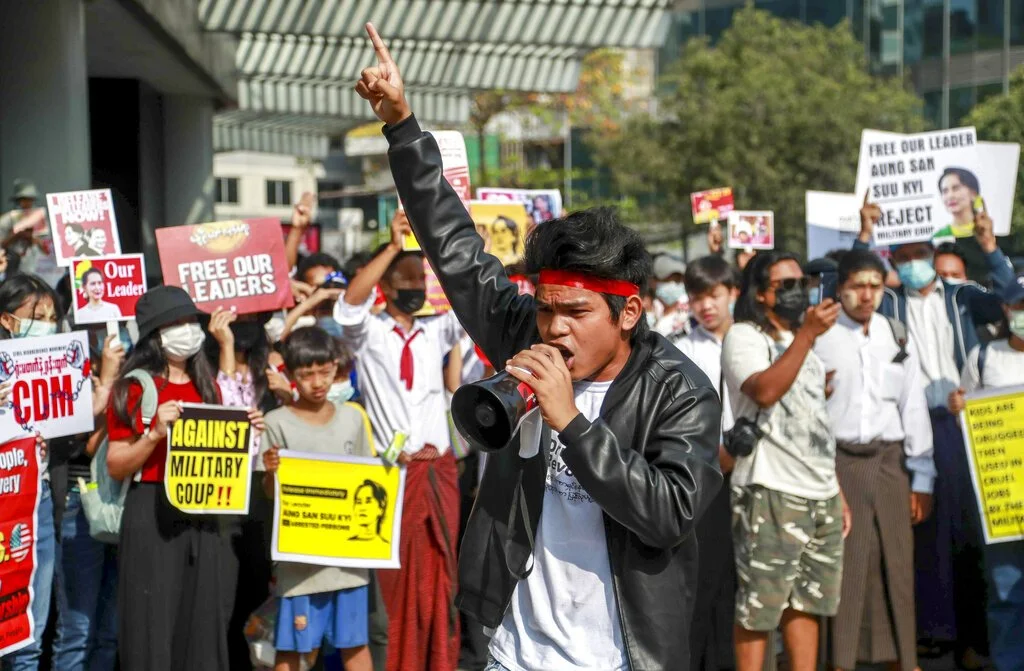
An anti-coup protester shouts slogans in Yangon, Myanmar Thursday, Feb. 25, 2021. Social media giant Facebook announced Thursday it was banning all accounts linked to Myanmar’s military as well as ads from military-controlled companies in the wake of the army’s seizure of power on Feb. 1.(AP Photo)
On April 8, 2026, Swedish non-profit organization, Justice & Accountability Initiative (JAI), filed a class action lawsuit against the Norwegian telecommunications company, Telenor Allmennaksjeselskap (ASA), on behalf of Myanmar citizens. With support from the Open Society Justice Initiative (OSJI) and Centre for Research on Multinational Corporations (SOMO), JAI claims that Telenor has been sharing data with the Myanmar military that consists of individuals who opposed their rule over their government, all while Telenor was allegedly aware of the systematic human rights violations.
In the 2020 Myanmar election, the National League for Democracy (NLD), won the majority of seats in the country's legislature. The Union Solidarity & Development Party (USDP), which is known to be aligned with the military, rejected the results and declared that the election was rigged although the electoral commission contradicted such claims. After the military’s request to delay the opening of parliament was denied, Burmese Senior General Min came out to warn that constitutional rights may be revoked under the circumstance that laws are not followed. A month later, on February 1, 2021, a military coup seized power from the democratically elected government, sparking nationwide resistance to military rule. A humanitarian crisis arose as severe conflict between activist citizens and the military took over the streets with serious human rights violations.
A few months later, in July of 2021, Telenor ASA announced that they were selling their Myanmar subsidiary with all sensitive data to a Myanmar “military-linked” company. After building an innocent image and trust with Burmese users, The Guardian writes that Nini Sandborg, a Myanmar-based human rights lawyer for the United Nations (UN), “says the company breached its trust” as activists “probably believed Telenor, as an international company, would have protected them.”
Based in the Nordics and Asia, Telenor serves over 160 million customers, managing sensitive information such as “large volumes of call data, location information, and traffic patterns” that, if breached, can “provide state-backed actors with unique opportunities to track…persons of strategic interest,” according to the Telenor website. The JAI filed the lawsuit before the Asker and Bærum District, providing that over 1,200 activists have been arrested after their data—consisting of last known locations—was handed over to the Myanmar military regime. They argue that the company failed to inform and protect users, as transparency reports made in 2021 by Telenor themselves report “96% of the 153 data requests it received” were turned over.
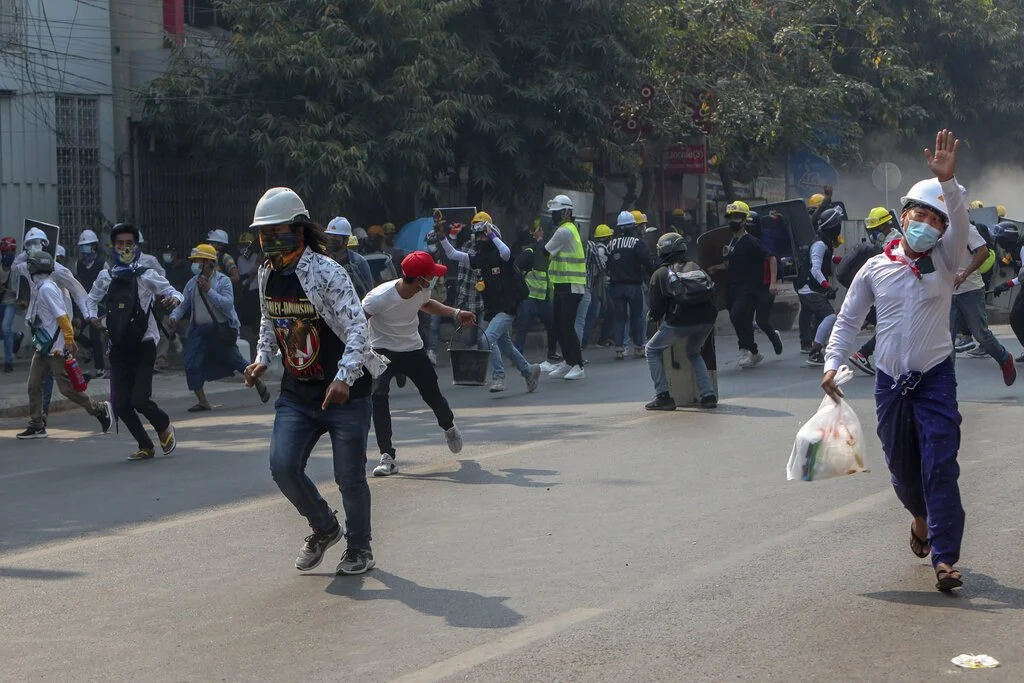
Anti-coup protesters run from teargas and charging riot police and soldiers in Mandalay, Myanmar, Wednesday, March 3, 2021. Demonstrators in Myanmar took to the streets again on Wednesday to protest last month's seizure of power by the military. (AP Photo)
SOMO goes into detail on two individuals who fell victim to injustice when their human rights were violated by the Myanmar military: Phyo Zeya Thaw, a prominent lawmaker and rapper, and Aung Thu, a civil society activist, both of whom are represented in the case. According to SOMO, although aware that his rights to safety would be affected, Telenor shared sensitive information related to Zeya Thaw with the military, resulting in his execution in January of 2022. Aung Thu was first arrested in September of 2021, released, and then re-arrested at the prison gate in October on charges related to terrorism laws. He subsequently underwent a non-transparent trial before being released again in 2025.
According to Amnesty International, this isn't the first time Myanmar has faced violence promoted by large technological corporations. The human rights organization reported that Facebook was a contributor to the Rohingya people being “killed, tortured, raped, and displaced as part of the Myanmar security forces’ campaign of ethnic cleansing.” Although Facebook presented itself as a neutral platform, just misused, Amnesty records that algorithms encouraged violent hatred against the Rohingya community from 2012 until it became real in 2017. The organization goes on to state that governments are obligated under international law to protect human rights, and therefore must stand against Big Tech companies that harm them. In the wake of growing international scrutiny, following the military coup in 2021, Facebook announced that they were banning accounts and ads linked to the Myanmar military as a diplomatic effort.
On October 20, 2025, SOMO stated that Telenor replied to the pre-lawsuit notice by explaining that they had no choice but to comply with the Myanmar military to protect their employees. With the official filing of the case, both parties now wait for the court to confirm whether the case can be tried as a class action, while Telenor also has “the opportunity to formally respond to the claims”.