
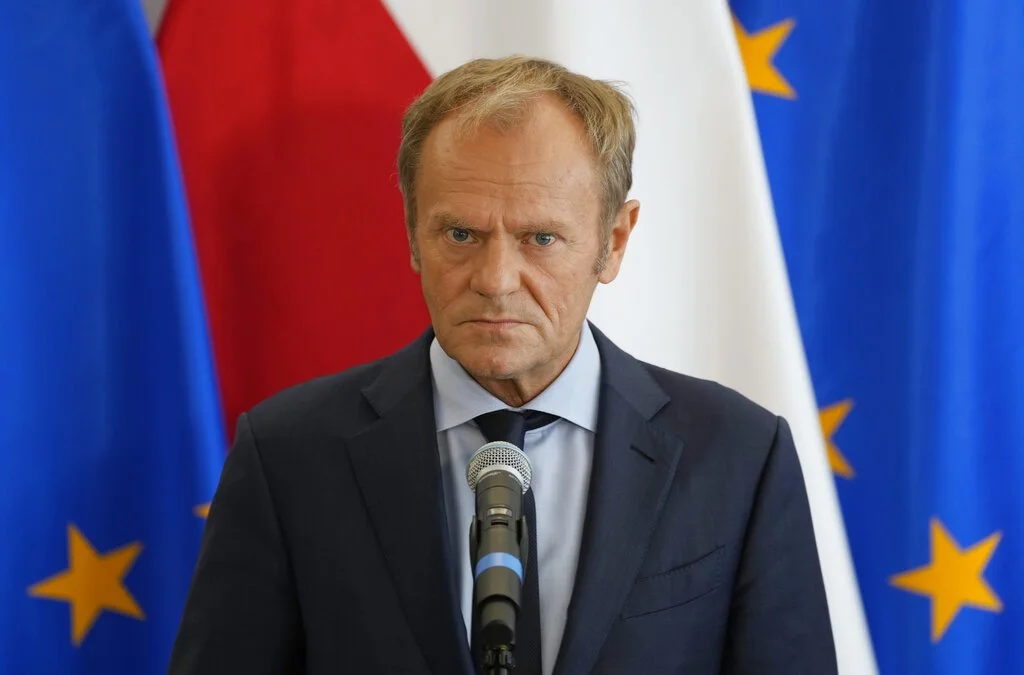
Former European Union head and Poland's ex-prime minister Donald Tusk speaks to journalists following his meeting with a political ally, Senate Speaker Tomasz Grodzki, at the Senate building, in Warsaw, Poland, on Tuesday, July 6, 2021. Tusk recently took leadership of the opposition, vowing to fight the current right-wing government. (AP Photo/Czarek Sokolowski)
President Karol Nawrocki and Prime Minister Donald Tusk have found themselves on opposing sides of an increasingly bitter dispute. The latest escalation in this feud came after a judge elected by the governing majority suspended the constitutional court's leadership and declared herself in charge, prompting protests outside the building and a significant police presence. The move has also sparked accusations that the court's authority is being unlawfully challenged.
On Oct. 30, Judge Anna Korwin-Piotrowska, one of the five parliament-elected judges whom Nawrocki has refused to swear in, suspended Constitutional Tribunal President Bogdan Swieczkowski and his deputy, Bartlomiej Sochanski, for one month. Both were elected to the tribunal by Parliament during the rule of the Law and Justice (PiS) party, which governed Poland from 2015 to 2023.
Nawrocki, who has close ties to PiS, cut his visit to Senegal and swiftly returned to Warsaw. He subsequently entered the court building despite the protests outside, accusing Tusk's government of attempting to take control of a constitutional institution.
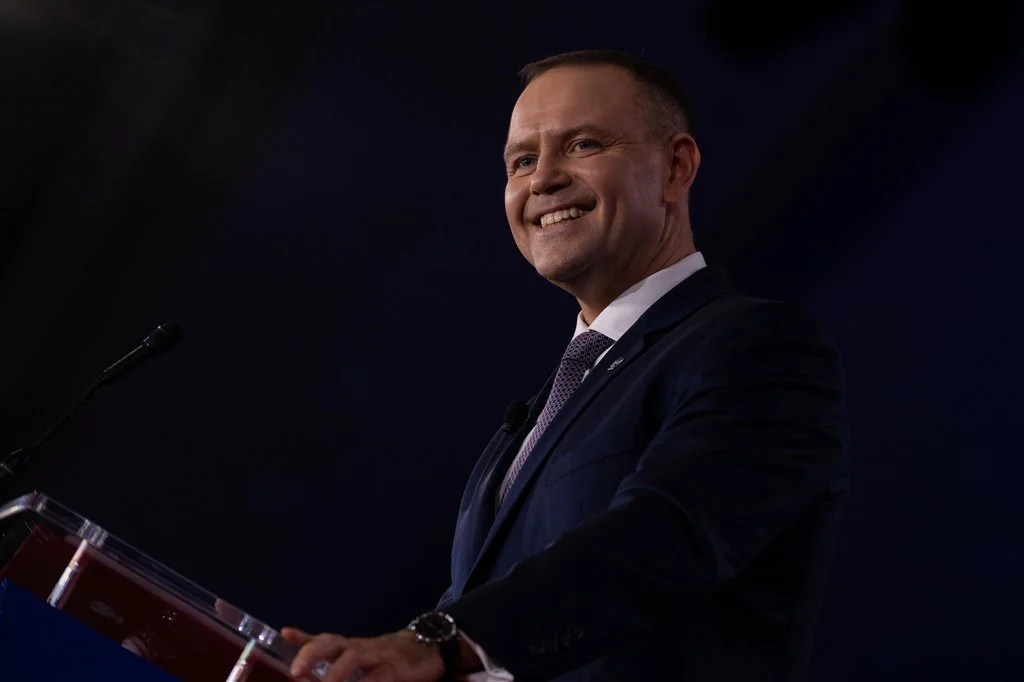
Polish President, Karol Nawrocki, smiles at CPAC attendees during speech about U.S. and Poland relationship and the importance of conserving a country's heritage at the Conservative Political Action Conference (CPAC) in Dallas, Saturday, March 28, 2026. (AP Photo/Gabriela Passos)
Tusk has defended the developments, describing them as part of his government's wider effort to restore judicial independence. He maintains that the tribunal's previous leadership had prevented judges elected by the current parliament from taking up their positions.
The Constitutional Tribunal is one of Poland's most important legal institutions. It determines whether legislation complies with the Constitution and has the power to invalidate laws that fail to meet constitutional requirements. Its rulings can significantly affect the balance of power between the government, parliament, and other state institutions.
The current conflict has its origins in 2015, when PiS took office and began introducing changes to Poland's judicial system. The reforms faced strong criticism from European institutions and political opponents who argued that the party was weakening judicial independence through politically influenced appointments. PiS defended the changes as necessary to improve the country's legal system.
Tusk's coalition, which came to power in 2023 on a pro-European platform, pledged to reverse many of those reforms. However, its plans have encountered resistance from Nawrocki, who assumed the presidency in 2025 and has refused to swear in five judges elected by parliament.
As a result, this has left the tribunal facing a fundamental disagreement over the legitimacy of its membership and the authority of its leadership.
The situation became more complicated on Nov. 3, when eight judges elected by the current parliamentary majority gathered to approve the court's proposed budget for 2027. During the meeting, they also initiated disciplinary proceedings against the suspended leadership.
The legality of the meeting has since become another point of contention. Under the tribunal's standard procedures, at least 10 of its 15 judges must be present for decisions to be valid. The eight judges who attended argued that three other members were not eligible to serve, bringing the required quorum down to eight. Nawrocki and several legal experts have rejected that position.
The developments have also prompted concern among international organizations that monitor judicial independence. On Nov. 3, the International Commission of Jurists warned that both the president's refusal to recognize the parliamentary appointments and the suspension of the tribunal's leadership could undermine respect for the rule of law.
The European Commission, meanwhile, has backed parliament's authority to appoint judges, stating that the selection of new Constitutional Tribunal members falls within the powers granted to the Polish legislature under the constitution.
The latest crisis also revives concerns about Poland's relationship with the European Union. In 2017, the European Commission initiated proceedings against Poland over questions surrounding judicial independence. These proceedings were brought to an end in May 2024, following commitments by Tusk's government to restore the rule of law.
Beyond its domestic implications, the confrontation comes at a time when Poland holds an important position in European security. As a NATO member bordering Ukraine, Belarus and Russia's Kaliningrad region, the country is central to the alliance's eastern flank. The prolonged political dispute has added to the challenges of cooperation within Poland at a time when security concerns across the region remain significant.
The timing is also politically sensitive, with parliamentary elections approaching in 2027. Tusk's coalition will be looking to secure another term, while PiS remains its principal political rival. Both sides have portrayed their actions as efforts to defend the constitution, ensuring that the future of the Constitutional Tribunal is likely to remain a contentious issue in the run-up to the vote.
In an attempt to ease tensions, Tusk has offered to meet Nawrocki privately to discuss a possible solution. However, neither side has shown much indication of changing its position.
For now, the dispute over the tribunal's leadership remains unresolved. At its heart is a broader disagreement over the limits of presidential and parliamentary authority, with both sides claiming to act in defense of Poland's constitution. Until that conflict is settled, the country's constitutional court is likely to remain at the center of the political standoff.