
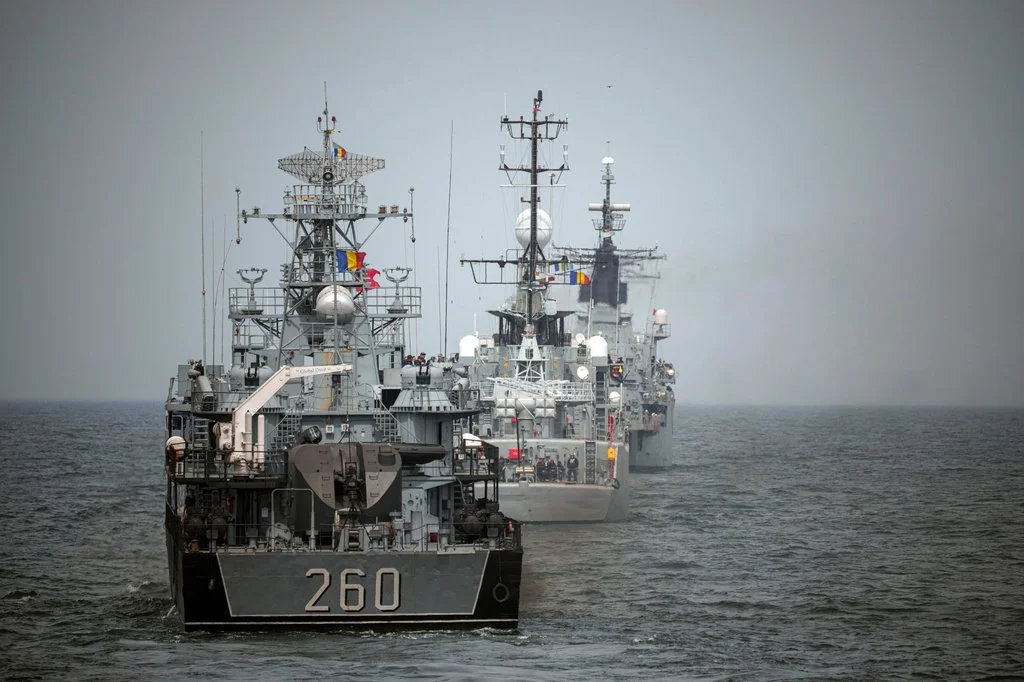
Romanian warships sail during a Romanian Navy led exercise outside Constanta, Romania, on April 16, 2024. (AP Photo/Andreea Alexandru, File)
Eleven crew members went missing on October 13th after a drone strike sank a cargo ship off Bulgaria’s coast, potentially marking the area’s second fatal cargo-vessel sinking in a week and leading Bulgaria to summon Russia’s ambassador. The Guinea-Bissau-flagged cargo ship was struck by a drone and sank near the town of Shabla, with the attacks later being condemned by both Ukraine and the EU.
Although Bulgarian Prime Minister Rumen Radev stopped short of directly blaming Russia for the attacks, he stated that their outcome “benefits the Russian Federation.” There was no immediate comment from Moscow regarding the incident.
However, this has not been the only recorded ship sinking attributed to an attack in the Black Sea in recent weeks. There have been numerous attacks off the coasts of Romania, Russia, and other parts of Bulgaria, all involving commercial vessels that have been struck by drones, caught fire, or sunk.
Just a week prior to the attacks on October 13th, a similar incident happened with two commercial vessels, named “Alfa Watan” and “Able”, located in the same general region of the western Black Sea. The attacks took place off Bulgaria’s eastern coast, within its exclusive economic zone. While Bulgarian authorities said that the origin of the drones was unclear, Ukraine’s president Volodymyr Zelenskyy blamed Russia for the drone strikes, noting that the Ukrainian military didn’t conduct any operations that night near where the vessels were struck.
Bulgarian Prime Minister Rumen Radev condemned the attack, noting, “What is happening is seriously disrupting shipping in the Black Sea, driving up insurance costs even further and making shipping extremely difficult,” and warned that the war was gradually expanding and increasing the risk for a global conflict.
In a telephone conversation with European Commission President Ursula von der Leyen and NATO Secretary General Mark Rutte on Tuesday, October 13th, Radev called for their assistance in strengthening Bulgaria’s maritime and airspace surveillance capabilities, according to a statement from the Bulgarian government. "The Black Sea has become another front of escalation of the Russian war in Ukraine," von der Leyen said on X. "Those responsible should be held accountable." NATO would continue to adjust its military presence on its eastern flank "as needed", Rutte affirmed.
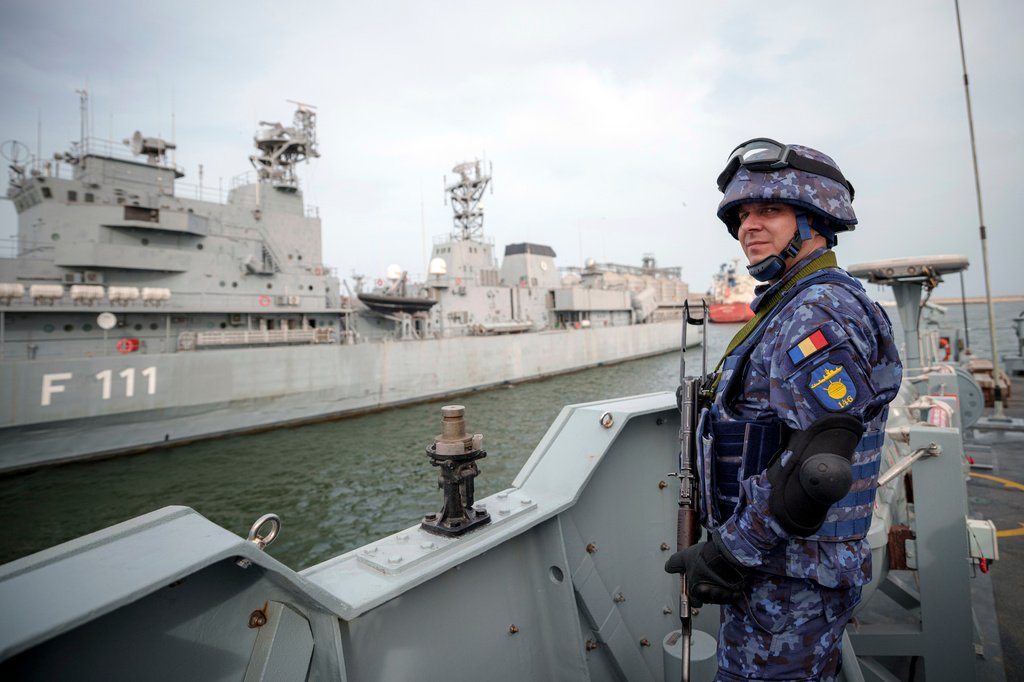
A Romanian naval serviceman guards onboard the M-270 Mine-hunter during a Romanian Navy led exercise outside Constanta, Romania, Tuesday, April 16, 2024. (AP Photo/Andreea Alexandru, File)
While many of the recent incidents have raised suspicion of Russian involvement, some incidents have also raised suspicions of Ukrainian involvement. One such incident occurred on October 6, when the Liberian-flagged oil tanker Aframax Rio was struck by a naval drone off Russia’s Black Sea coast, resulting in a fire and black smoke cloud, according to Russian authorities. Russia’s transport ministry reported that all 23 crew members were rescued. There was no comment from Kyiv on the attack.
Since the start of the Russia-Ukraine war, commercial shipping in the Black Sea has become an increasingly important part of the broader economic struggle, given the region’s strategic role in transporting Russian energy exports, Ukrainian grain, and other agricultural products.
The latest incidents occurred on October 14 and 15, when drone strikes hit two chemical tankers near Romania’s Black Sea coast, setting both vessels ablaze and leaving seven crew members missing. The two vessels were anchored near the mouth of the Sulina Canal, which connects to the Danube River, a key export route for Ukraine amid repeated Russian attacks on Ukrainian Black Sea ports.
Earlier that week, Romanian Foreign Minister Oana Toiu emphasized the Black Sea’s importance to global food security at a security conference in Warsaw. "We're looking at the Black Sea as a global food artery," she said, warning of growing dangers for sailors and calling for greater investment in deterrence and defence. A NATO source later on confirmed that the drones that caused the fires on board the 2 vessels were Russian.